E12 smart bulb selection: 5 common mistakes to avoid
You bought a chandelier for the atmosphere. Six brass arms, warm glass shades, the promise of a dining room that hums at sunset.
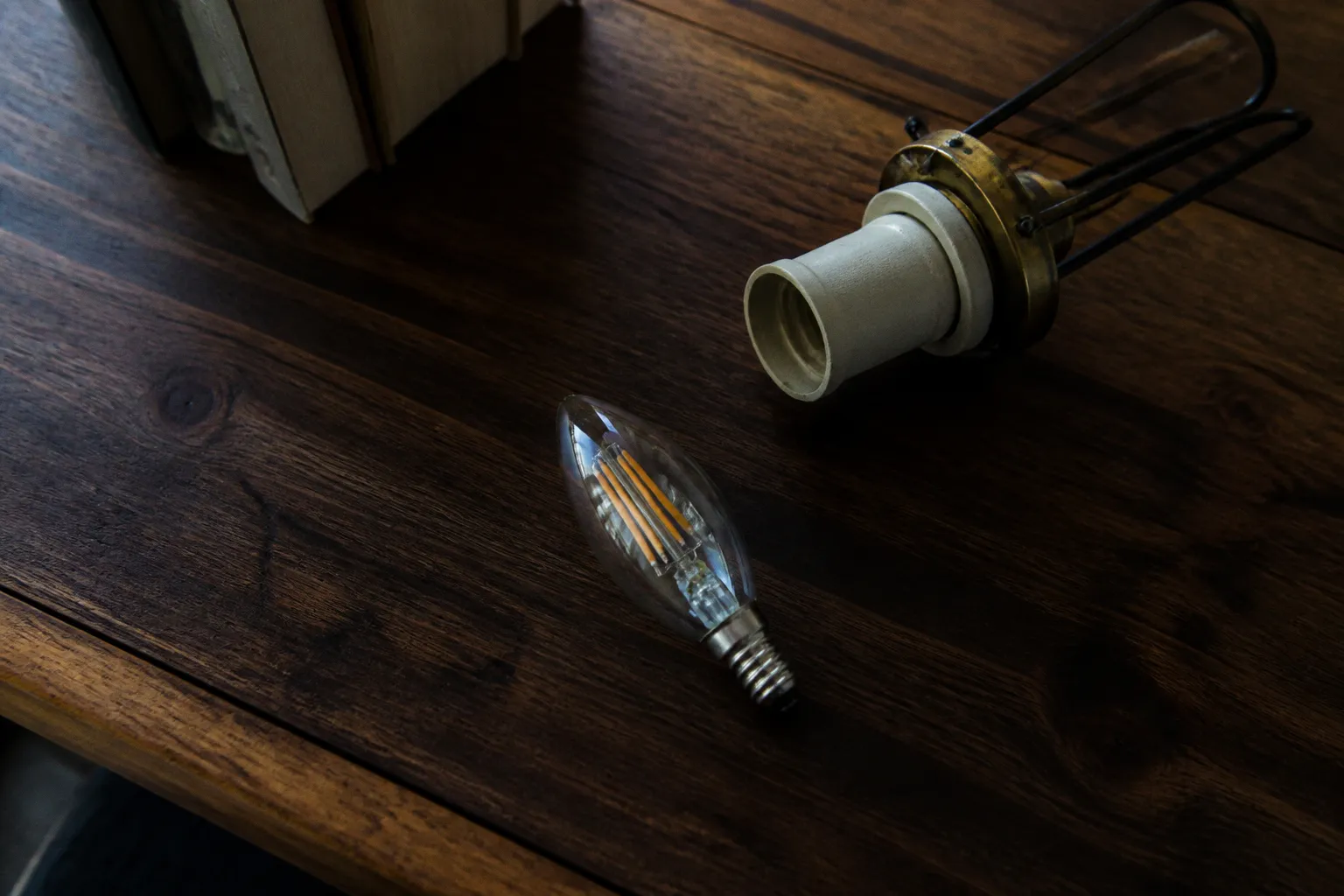
E12 smart bulb selection: 5 common mistakes to avoid
Then you ordered a six-pack of E12 smart bulbs and reality hit the room before the bulbs did: three don't seat flush against the shades, one buzzes the moment you flip the wall switch, and the other two refuse to talk to anything in your smart home stack. The chandelier goes back to being a dumb fixture, and you're left holding $60 worth of beautiful, expensive paperweights.
This isn't a fringe story. The candelabra smart bulb market has matured fast, and the maturity has come with a minefield of compatibility traps that never make it onto the product page's hero image. The screw base matches — sure — but "matches" is doing an enormous amount of heavy lifting. Here are the five mistakes that turn an atmospheric lighting upgrade into a return-label nightmare, and how to engineer past every one of them.
Mistake #1: Treating the E12 label as the whole specification
The first thing worth internalizing, firmly: E12 is a base designation, not a performance promise. E12 identifies the candelabra screw base — the small threaded socket you'll find in chandeliers, decorative sconces, certain ceiling fans, small nightlights, and ornamental pendants. It's the smaller sibling of the standard E26 medium base that dominates table lamps and ceiling fixtures across American homes. The number encodes none of the following: wattage, brightness, voltage, color capability, wireless protocol, or physical dimensions.
That distinction matters because consumers arrive at "E12 smart bulb" expecting a standardized product category. In practice, they're shopping a fragmented field where three different E12 smart bulbs from three reputable brands behave like three entirely different devices. IKEA's KAJPLATS E12 globe pushes 800 lumens at 6.5 watts with full Matter-over-Thread connectivity and RGB color. Govee's H600B candle bulb tops out at 450 lumens at 5.8 watts over Wi-Fi with tunable white only. GE Cync's B11 E12 sits at 450 lumens and connects directly to a 2.4 GHz Wi-Fi network with no hub required. Same screw base, radically different experiences.
E12 is a socket, not a spec sheet — the real differences between candelabra smart bulbs live in lumens, protocols, and physical dimensions.
The move is to stop shopping by base and start shopping by use case. What fixture are you filling? What atmosphere are you chasing? What ecosystem already lives in your home? The screw base is the ticket of admission; everything else is the show.
Mistake #2: The physical clearance trap and the enclosed-fixture hazard
LEDs run cooler than incandescents, but they are absolutely not smaller. The driver circuitry, heat sinks, and antenna components packed into a smart bulb push the diameter and height well past what a traditional candelabra bulb ever occupied. The U.S. Department of Energy has flagged this clearance issue explicitly: LED replacement lamps can physically crowd small fixtures in ways the old bulbs never did.
Look at the IKEA KAJPLATS E12 globe: 45 mm diameter, 79 mm height — nearly two inches across and just over three inches tall. In an open-armed chandelier with generous glass shades, that's a clean fit. In a tight bullet fixture, a vintage sconce with a narrow neck, or a ceiling fan light kit with a glass cover, that bulb may not seat properly — or worse, may force the shade to sit at an angle, clip against the housing, or refuse to close at all. The U.S. DOE acquisition guidance treats dimensional clearance as a primary physical compatibility check, not an afterthought.
Then there's the enclosed-fixture question. Enclosed globes and sealed sconces trap heat. Even efficient LEDs degrade faster when their heat dissipation is compromised, and smart bulbs with wireless radios run hotter still. GE Cync explicitly lists its E12 B11 as not enclosed-rated. LIFX echoes the warning: avoid fully enclosed fixtures unless the bulb is specifically LED-rated for them. If your fixture is a sealed vanity bar, a ceiling fan's enclosed light kit, or a tight outdoor sconce, that E12 smart bulb needs to declare enclosed-fixture compatibility on the spec sheet — otherwise, you're trading a few years of operational life for a slightly smarter switch.
Outdoor and damp-location ratings run on a parallel track. GE Cync's B11 carries a damp-location rating but explicitly excludes outdoor use. Candelabra sockets under a covered porch in a humid climate are fine. Sockets exposed to direct rain need wet-rated hardware — a different product category entirely.
Mistake #3: The wall dimmer lie
This is the one that burns people most consistently. A smart bulb advertises dimming — via the app, via voice, via automation — and the assumption follows that the wall dimmer switch on the circuit will play along. It almost never does.
The technical reality: traditional wall dimmers work by chopping the AC waveform to reduce power reaching the bulb. Smart LEDs already contain their own driver circuitry designed to receive a clean, full-power signal and handle dimming digitally. Feed that driver a chopped waveform from a legacy dimmer and you get the worst-of-both-worlds experience — flicker, buzz, erratic behavior, shortened lifespan, or outright refusal to illuminate. Govee's H600B documentation states the issue plainly: not for use with dimmer switches. LIFX advises the same — wall dimmers cause flickering, buzzing, and poor performance.
The fix isn't subtle. If your fixture is on a dimmer circuit, you have three options. Bypass the dimmer entirely and run the bulb at full power, controlled only through the app. Replace the wall dimmer with a standard on/off switch. Or, if you want both wall control and app control, install a smart switch that communicates with the bulb's ecosystem rather than chopping the AC signal.
App dimming and wall dimming are two different electrical conversations — and your candelabra smart bulb can only speak one of them.
The upside, once the conflict is resolved, is glorious. Smooth fades from full sunset amber to a barely-there ember glow, triggered by voice command or a time-of-day automation. The atmosphere transforms. But it transforms only after that incompatible wall dimmer is gone.
Mistake #4: The connectivity maze
Wi-Fi looks like the easy answer. Every router broadcasts it, every phone connects to it, so a Wi-Fi candelabra bulb should be plug-and-play. Mostly that's true — with three caveats worth knowing before the package arrives.
First: most smart bulbs, E12 included, operate only on the 2.4 GHz Wi-Fi band. The 5 GHz band is faster but has shorter range and poorer wall penetration, and the bulb's antenna and power budget aren't designed for it. If your phone sits on 5 GHz and your router's band-steering is aggressive, the setup process can stall mysteriously. Force the phone onto 2.4 GHz during pairing, then let it roam freely afterward.
Second: a chandelier with six E12 sockets means six devices on the home network. Six IP addresses, six DHCP leases, six potential failure points. On a consumer router already juggling security cameras, smart speakers, and streaming sticks, that chandelier can be the straw that turns pairing into an exercise in frustration.
Third — and this is the trap that catches everyone planning a future-proof install — Matter compatibility doesn't automatically mean hub-free. Matter is a protocol layer, not a network technology. Underneath that layer, the bulb still needs to talk to something. IKEA's KAJPLATS E12 uses Matter over Thread, which means it requires a Thread Border Router to bridge into the Wi-Fi network and reach the phone. Without that border router — sold separately in IKEA's case — the bulb is invisible to the app, even though it carries the Matter badge on the box.
Here's how the three reference models actually stack up:
| Spec | Govee H600B | GE Cync B11 | IKEA KAJPLATS |
|---|---|---|---|
| Form factor | E12 candle | E12 B11 | E12 globe |
| Lumens | 0–450 | 450 | 800 |
| Wattage | 5.8 W | not specified | 6.5 W |
| Color range | Tunable white 2700–6500K | Tunable white | RGB + 2200 / 2700 / 4000 / 6500K |
| Connectivity | Wi-Fi | 2.4 GHz Wi-Fi direct | Matter over Thread |
| Hub required | No | No | Yes — Thread Border Router |
| Rated life | not specified | 15,000 hr | 25,000 hr |
| Enclosed / outdoor | Not for wall dimmers | Damp-rated, not enclosed, not outdoor | Check current spec sheet |
The pattern: cheaper Wi-Fi bulbs are easier to install, but each one is another device draining the network budget. Thread-based Matter bulbs are more elegant long-term but demand infrastructure the household may not yet own. There's no universal winner — just the right answer for the setup already in place.
Mistake #5: Spec-sheet brightness without the mood
Lumens measure light output. They do not measure atmosphere. And atmosphere is the entire reason for upgrading from incandescent candelabras to smart LEDs in the first place.
A 450-lumen bulb in a chandelier with six arms delivers 2,700 total lumens — roughly equivalent to a 200-watt incandescent fixture. That's a lot of light. It will illuminate a dining table. It will also flatten the room into a single brightness register, because every bulb sits at the same intensity, the same color temperature, and the same color. Functional, yes. Cinematic, no.
Now imagine six 800-lumen bulbs, individually addressable, on independent routines. Dinner mode: four bulbs at 2200K amber at 30 percent, two bulbs off entirely. Late-night reading: two bulbs at 4000K neutral white at 80 percent, the rest dimmed to 5 percent ember. Movie time: all six at a deep 2200K orange at 15 percent, casting the room in candlelight tones that make a streaming session feel cinematic. The lumen count didn't change the capability — the color, the zoning, and the dimming curve did.
Color temperature range matters enormously here. Govee's H600B covers 2700K to 6500K — warm white to cool daylight, no color. That's a competent tunable white experience, useful for task lighting and circadian routines. IKEA's KAJPLATS goes further: 2200K, 2700K, 4000K, and 6500K white presets plus full RGB. The 2200K setting is the magic one — the color of candlelight, of late sunset, of the warm edge of an incandescent filament. Without that deep-warm capability, "dinner mode" looks like a slightly dimmed bulb. With it, the dining room looks like a film set.
This is where smart lighting stops being a utility upgrade and becomes an aesthetic medium. Content creators figured this out early — the lighting setups behind your favorite streamers and YouTube creators lean heavily on precisely these tunable candelabra and accent configurations to shape on-camera atmosphere. The same trick translates directly to a living room, and the right E12 smart bulb is the entry point.
Color rendering index matters in the spaces where color accuracy actually shows. CRI 90 — which IKEA publishes for the KAJPLATS — means colors under that light render close to how they look under natural daylight. Reds stay red. Wood grain stays warm. Food stays appetizing. CRI 80 is fine for hallways and utility spaces. For the dining room, the vanity, the art display, the place where eyes actually rest — push for CRI 90.
Building the chandelier you actually wanted
Before the order ships, measure the fixture's internal clearance — the diameter at the narrowest point and the depth from socket to shade. Match that against the bulb's published dimensions, not just the base thread. Confirm the enclosed or damp rating against the fixture's environment. Check whether the circuit runs through a wall dimmer, and resolve that conflict before opening the box.
Decide on ecosystem first, bulb second. Households already running Apple Home with a Thread-capable HomePod can drop the IKEA KAJPLATS E12 in cleanly. Homes standardized on the Govee app keep the H600B in one tidy interface. Buyers who want Wi-Fi direct-connect with no extra hardware and live inside the Cync app find GE's B11 the path of least resistance. The "best" bulb is the one that integrates with the system already maintained — not the one with the most aggressive spec sheet.
Then choose brightness by purpose. Decorative chandelier with six arms? 450 lumens per bulb is plenty when they all contribute. Single-bulb sconce or pendant? Push to 800 lumens or higher so the fixture actually carries the room. Vanity lighting where faces need to read true? Prioritize CRI 90 and a wide tunable white range over raw output. Accent lighting where mood wins? RGB plus a deep 2200K minimum are non-negotiable.
The right E12 smart bulb isn't the one with the highest lumen count — it's the one whose ecosystem, color range, and physical profile disappear into the fixture and leave only the atmosphere behind.
The candelabra socket was a decorative afterthought for decades — small bulbs, low output, ignored by the smart home revolution while the rest of the house got connected. That era is over. The current generation of E12 smart bulbs delivers real brightness, real color, real ecosystem integration, and real atmosphere control. Shop past the screw base, past the spec sheet, past the marketing photos, and the result is a room that feels different every time the door opens. That's the upgrade worth making.