Pick Philips Hue or LIFX smart bulbs for your home lighting
You've cleared off the shelf, you've measured the lampshade, and you've finally decided it's time to swap out those old incandescent bulbs for something that actually listens to your phone.
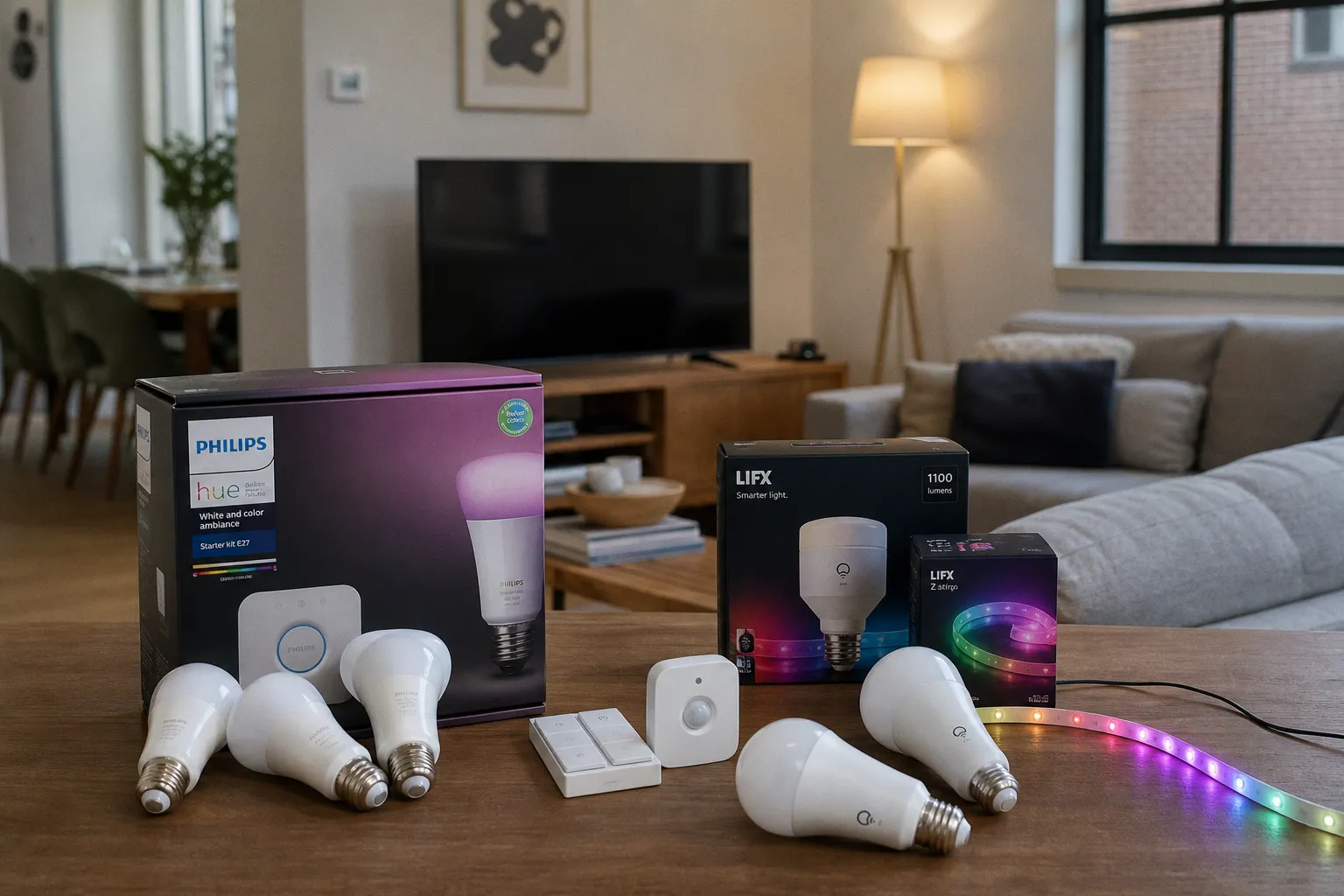
Pick Philips Hue or LIFX smart bulbs for your home lighting
This is the kind of choice that doesn't feel huge in the moment, but it is. Because once you've wired your home around one ecosystem, swapping it out is a weekend project, not an errand. So let me walk you through what each one actually does well, where it stumbles, and which one matches the way you already live. No spec-sheet theater — just the things you'll notice when the lights come on at the end of a long day.
The Connectivity Trade-off: Zigbee Bridge Stability vs. Wi-Fi Simplicity
Let's start where the buying decision actually starts: how these bulbs talk to your home network.
Philips Hue runs on Zigbee, a low-power wireless protocol that needs a dedicated hub — the Hue Bridge — to translate between your phone and the bulbs. The Bridge costs extra, plugs into your router with an ethernet cable, and can coordinate up to 50 lights at once. The trade is reliability: Zigbee creates its own little mesh network, so your bulbs aren't competing with your streaming, your work calls, or the smart plugs your partner keeps adding to the kitchen counter.
LIFX skips the hub entirely. Every bulb connects straight to your 2.4GHz Wi-Fi, which means less hardware on your shelf and a faster setup if you're only putting in one or two bulbs to start. The trade is that each bulb eats a slice of your router's bandwidth, and if your router is older, lives in a closet, or is already juggling a dozen devices, you'll feel it eventually.
In real homes, this looks like this: a single LIFX bulb in a bedside lamp is delightful — it turns on instantly, dims smoothly, and the app barely has to think. But six LIFX bulbs scattered across a long apartment can start showing the occasional lag, especially when someone's streaming 4K in the next room or you've got a smart doorbell, a robot vacuum, and three phones all pinging the router at once. A Hue setup with a Bridge, by contrast, tends to fade into the background after the first week. You stop thinking about the infrastructure, which is honestly the highest praise any smart home device can earn.
If you're going to fill a whole house with smart bulbs, the Hue Bridge earns its keep within a month. If you're lighting a reading nook, LIFX keeps things beautifully simple.
Lumens and Spectrum: Why LIFX Leads in Color Saturation and Brightness
Now for the part you actually see every evening: how bright these bulbs get and how rich their color really is.
The standard LIFX Color A19 bulb pushes up to 1,100 lumens at peak output. The standard Philips Hue White and Color Ambiance bulb typically lands between 800 and 1,100 lumens depending on which generation you've picked up. At a clean daylight white, the difference is barely noticeable — both are bright enough to read by, both can fill a small room without complaint.
Once you start dialing in deep reds, electric purples, and those moody ocean blues, LIFX pulls ahead because it leans harder into color saturation. LIFX claims up to 550 billion color combinations, and while you'll never count them, the difference shows up in the punch of a magenta or the depth of a teal — LIFX bulbs tend to render these with noticeably more wallop. The color temperature range tells a similar story. LIFX runs from 1,500K (a candle-lit amber, almost flame warm) up to 9,000K (a sharp, almost clinical daylight blue). Hue sits between 2,000K and 6,500K, which comfortably covers the practical spectrum you'll actually use in a home — warm reading light in the bedroom, neutral task light in the kitchen, cool overhead light in a home office.
Here's how this plays out in real routines. If you're the type who wants the living room to glow like a fireplace one evening and then crisp into office-bright the next morning, LIFX gives you more range to play with. If your idea of "smart lighting" is mostly dimming the overhead light without getting off the couch, and you rarely venture past the warm-white side of the spectrum, Hue's narrower range will never feel like a limitation.
| Parameter | Philips Hue (A19) | LIFX Color (A19) |
|---|---|---|
| Peak brightness | 800–1,100 lumens | 1,100 lumens |
| Color temperature | 2,000K–6,500K | 1,500K–9,000K |
| Color combinations | Millions | 550 billion |
| Connectivity | Zigbee via Bridge | 2.4GHz Wi-Fi direct |
| Average lifespan | 25,000 hours | 25,000 hours |
Beyond the Bulb: Comparing Hue's Hardware Ecosystem to LIFX's Standalone Power
A bulb is just the entry point. What makes a smart lighting system feel like a real system is everything you can hang off it.
Philips Hue has spent more than a decade quietly building out a sprawling accessory line. There are motion sensors that trigger hallway lights when you walk past at midnight, physical rotary dimmers your houseguests can actually find on the wall, outdoor-rated fixtures for the porch and garden path, and dedicated light strips for under cabinets or behind the TV. If your mental picture of a smart home involves lights reacting to motion, to the time of day, and to the doorbell ringing, Hue gives you the Lego pieces to build exactly that without duct-taping a dozen third-party brands together.
LIFX plays a different game. It focuses on fewer, more powerful standalone bulbs and a smaller lineup of feature-rich light strips. There's no Hue-equivalent motion sensor in the LIFX catalog, no dedicated wall-mounted dimmer. What you do get is a bulb that packs more processing into the fixture itself — which is exactly why features like multi-color zones on a single strip showed up on LIFX first. The trade is real: LIFX bulbs also tend to be physically larger and heavier than standard Hue bulbs, which can cause fitment headaches in compact or enclosed fixtures like vintage sconces or tight desk lamps.
So if your plan is to build out a whole-house lighting network, with sensors, switches, and outdoor zones all coordinated from one app, Hue is the more complete toolkit. If your plan is to drop a few wow-factor bulbs into the spots that matter most — the bookshelf, the media wall, the standing lamp next to your reading chair — LIFX keeps things focused without making you learn a second vocabulary.
Polychrome and Gradients: Mastering Multi-Color Zones and Dynamic Scenes
This is where smart lighting stops being "a colored bulb" and starts feeling like a piece of ambient art in your living room.
LIFX was the first brand to put true multi-color zones on a single light strip. Their Polychrome Technology, available on products like the LIFX Beam and the Z-Strip, lets one physical strip paint several different colors at once — a smooth gradient running from amber to pink to violet along your media console, with each color zone driven independently from the rest. Hue matched this capability with its Gradient line, including the Lightstrip Gradient and the Play Gradient Lightstrip, both of which can layer colors along their length when paired with a Hue Bridge.
In the living room, this is the feature that turns a quiet movie night into something that feels quietly theatrical. The wall behind the TV shifts with the color palette of the film, the strip under the shelf picks up the highlights, and the room subtly breathes with what's on screen. In a gaming setup or a home theater, it's the difference between ambient lighting and immersive lighting — your space stops being a room and starts being part of the experience.
Both brands also support dynamic scenes: slow color cycles, fireplace flicker, candle flicker, "northern lights" simulations. The execution differs slightly. LIFX tends to ship with bolder, more saturated defaults straight out of the box, which is great if you want the wow factor on day one. Hue's scene library is larger and easier to browse, partly because of its longer head start and partly because a much bigger user community has built and shared custom scenes over the years.
Hue's Gradient line and LIFX's Polychrome strips are the closest two products you'll find to wall art that listens to your screen.
Matter Integration and the Long-Term Future of Your Smart Lighting Network
Matter is the new common language that smart home brands have been promising for years. It's the protocol designed to let your bulbs, your thermostat, your door lock, and your voice assistant all speak one shared dialect without you having to babysit six different apps on a Tuesday night.
Philips Hue added Matter support to its Bridge through a firmware update in 2023. Once your Bridge is running the new firmware, the bulbs it controls can show up in Apple Home, Google Home, Amazon Alexa, and any other Matter-certified controller. For Hue, this transition has been relatively smooth because the Bridge was already the central piece of the puzzle — Matter just rides on top of it. The Hue bulbs themselves don't speak Matter natively; the Bridge translates for them, which is honestly a fine arrangement if you've already invested in the ecosystem.
LIFX has announced Matter support for newer models in its lineup, including newer ceiling lights and outdoor path lights released in 2024. The honest caveat is that older legacy LIFX bulbs may not be eligible for Matter firmware updates. If you've already built a small fleet of LIFX bulbs over the past several years, that's worth verifying on the support site before you plan a Matter-first smart home around them.
This is also where the broader conversation about managing connected services starts to creep in. Once you've got lights, locks, thermostats, and voice assistants all trying to coordinate, you want fewer apps fighting for your attention, not more. Matter is the industry's answer to that impulse. Both brands are participating in it, but Hue has had a longer runway so far, and that shows in how polished its Matter rollout has felt compared to a brand still catching up across its older hardware.
Who Each System Actually Fits
Let me bring it all back to the rooms you actually live in.
Here are the situations I'd point you toward Philips Hue:
- You're planning to roll out smart bulbs across most rooms in the house, not just one or two showpiece spots.
- You want physical switches and motion sensors alongside your app controls, especially if you have guests who never install the app.
- Your router is older or pushed to its limits, and you'd rather keep smart bulbs off your Wi-Fi network entirely.
- You care about polish and longevity more than maxed-out color punch on a single bulb.
- You want one ecosystem that's been refined for over a decade and isn't going anywhere.
And here are the situations where LIFX makes more sense:
- You're lighting one or two high-impact rooms — a media wall, a gaming setup, a reading nook where color matters.
- You want the absolute brightest, most saturated color a single bulb can deliver without fussing with a hub.
- You don't want another piece of hardware on your shelf and don't mind leaning on a strong Wi-Fi router.
- You're happy with app-only control and don't need physical wall switches.
- You like the idea of fewer, more powerful devices instead of a sprawling accessory catalog.
Neither choice is wrong. They're just different philosophies of what a smart home is supposed to be: Hue builds the house, LIFX builds the statement piece. Pick the one that matches how you actually spend your evenings, and within a week you'll stop thinking about your lighting setup entirely — which, honestly, is the highest compliment any smart home device can earn.