WiFi smart bulb selection: which features actually matter?
: Which Features Actually Matter?
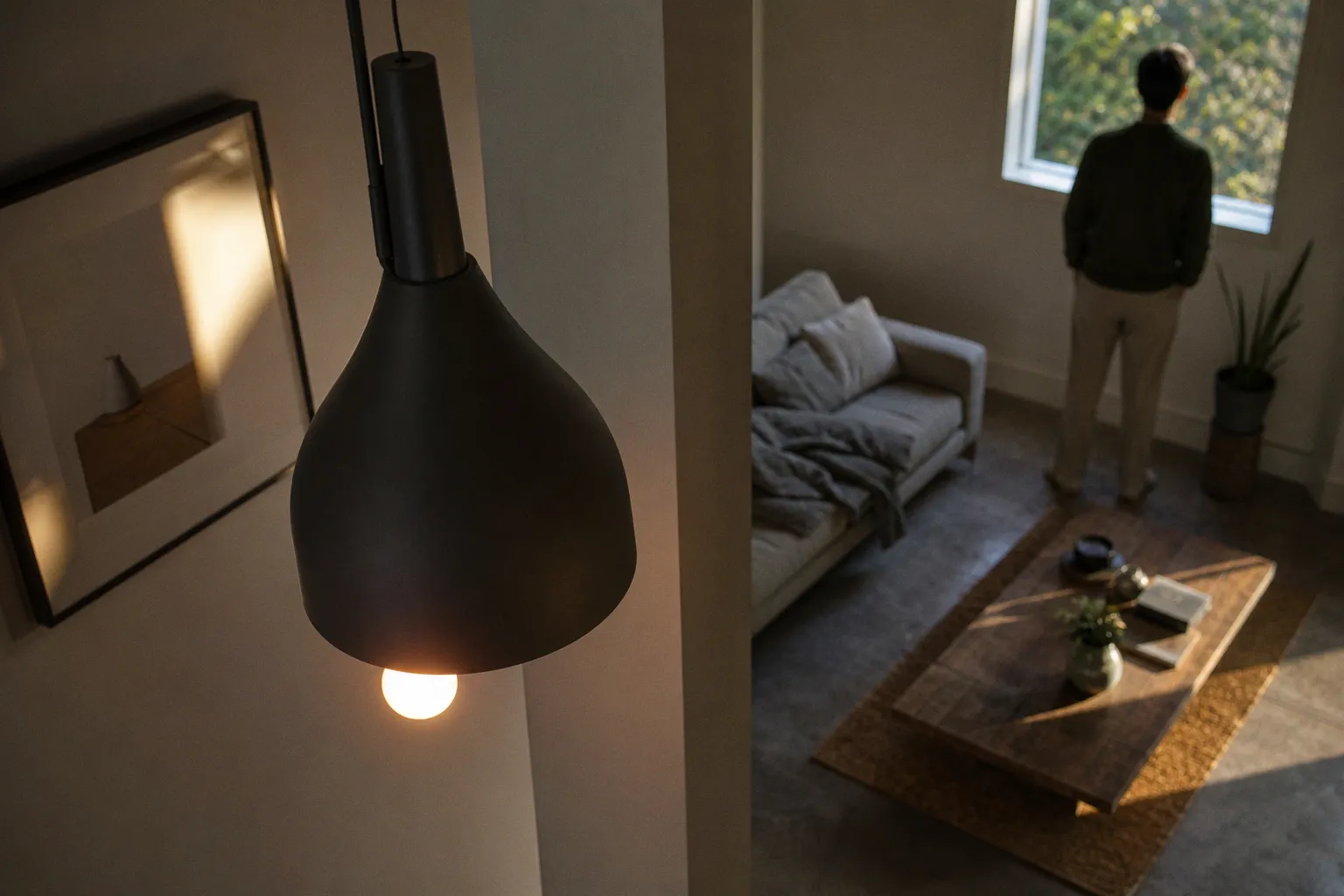
The bulb said "60W equivalent" on the box. It produced the kind of light that made my home office look like a Victorian coal cellar. I've been called in to debug automations that look correct on paper and fail at the lumen level — a motion sensor triggers at dusk, the bulb fires, the room stays dim, and the user assumes the hub is broken. The hub is fine. The bulb simply doesn't output enough light to do the job. Shopping for WiFi smart bulbs without comparing actual lumen ratings is like buying a network switch because the box says "gigabit." Marketing copy is an unreliable variable; the spec sheet is the contract.
A "60W equivalent" LED that ships 600 lumens isn't equivalent to anything except disappointment.
Decoding Brightness: Why Lumens Replace Watts
Watts measure energy draw. Lumens measure light output. For a century those numbers tracked each other — a 60W incandescent always produced a predictable glow — so the consumer brain wired "more watts" to "more light." That shortcut is wrong now. A modern LED bulb can deliver the same light as a 60W incandescent on 8 to 10 watts, and a cheap LED can deliver less light than a 60W incandescent on the same wattage. Wattage is no longer a proxy for brightness.
ENERGY STAR's published mapping for common incandescent replacements is the cleanest reference frame for what you actually need:
| Incandescent replacement | Minimum lumen output (ENERGY STAR) |
|---|---|
| 40 W | 450 lm |
| 60 W | 800 lm |
| 75 W | 1,100 lm |
| 100 W | 1,600 lm |
| 150 W | 2,600 lm |
These are floors, not ceilings. If you're lighting a kitchen island, a reading nook, or anywhere you do detail work, you want the next step up at minimum. A 60W-equivalent bulb that hits exactly 800 lumens will technically satisfy the spec; in practice, that living room is going to feel underlit at night. Anything sold as "60W equivalent" should be cross-checked against the actual lumen figure on the product page — and if the page only says "60W equivalent" with no number, treat it as a red flag and move on.
Two more variables complicate the brightness question. First, beam angle: a "800 lumen" bulb in a narrow spotlight throws a hot pool of light; the same bulb in a wide-diffusion A19 spreads it across the room. The lumen number doesn't tell you where the light lands. Second, dimming range: many WiFi smart bulbs advertise dimming from 1% to 100%, but the low end varies wildly. Some bulbs become visibly noisy (flicker, shimmer, or buzz) below 10%; others hold clean light down to 1%. If you build a "movie mode" scene that drops the bulbs to 5% and the bulbs can't actually go there cleanly, your scene looks like a hardware glitch.
Finally, remember that feature scope raises the bill. ENERGY STAR notes that additional capabilities — tunable white, full RGB color, scenes, geofencing, sensor integration, voice-assistant hooks — generally increase the unit price. A bulb that costs twice as much as its plain-white sibling is paying for firmware and LED channels, not raw brightness. Don't pay the RGB premium for a closet bulb.
Color Temperature and Quality: Understanding Kelvin and CRI
Kelvin tells you the mood of the light; lumens tell you whether you can read. They are independent specs and a frequent source of confusion. A bulb can be 800 lumens and 2700K (warm yellow-white) or 800 lumens and 5000K (cool blue-white) — same brightness, totally different room.
Correlated color temperature (CCT) is measured in kelvin. Lower values are warmer and yellower; higher values are cooler and bluer. The standard reference points:
| CCT range | Visual character | Typical use |
|---|---|---|
| 2200–2700 K | Warm, candlelit, amber | Bedrooms, dining rooms, accent lighting |
| 2700–3000 K | Classic warm white | Living rooms, general residential |
| 3500–4000 K | Neutral white | Kitchens, bathrooms, task areas |
| 4000–5000 K | Cool white / daylight | Offices, garages, workspaces |
| 5000–6500 K | Bright daylight, blue-leaning | Commercial, photography, workshops |
If a WiFi bulb advertises "tunable white," it's covering a slice of this range — typically 2200K to 6500K. If it advertises "full color" or "RGB," it can produce those CCT whites and any hue in between, but RGB color accuracy varies dramatically across vendors. Some bulbs render reds as muddy oranges; others do it cleanly.
Color Rendering Index (CRI) is the second spec that matters for any room where appearance is the point. CRI — more precisely, the Ra value — describes how accurately a light source reveals object colors compared to a reference source of comparable color temperature. A higher Ra means colors look closer to how they'd look under natural light. For reference, ENERGY STAR's downlight program lists a color-quality criterion of Ra at least 80 and R9 above 0; that's a fixture-program threshold, not a universal rule for every consumer bulb, but it's the practical floor most buyers should treat as the minimum. Anything below Ra 80 will start to make skin tones look sickly and fabrics look washed out — and you won't always notice consciously, you'll just feel that the room "looks off."
Kelvin tells you the mood. Lumens tell you whether you can read. CRI tells you whether the room looks honest.
The mistake I see most often: buyers grab a "daylight 5000K" bulb for a living room because it sounds bright, then wonder why the space feels clinical. CCT is a design choice. Pick warm for living spaces, neutral for kitchens and work areas, and cool only where you're doing visual detail work or need alertness.
Connectivity Pitfalls: 2.4 GHz Requirements and Wall-Dimmer Limitations
Here's where most home installs go sideways, and it's almost never the bulb's fault.
First, the WiFi band. The 2.4 GHz band is the de facto standard for low-power smart home devices because it propagates further through walls and costs less in the radio. TP-Link's current Kasa smart-bulb setup guidance, for example, states that its bulbs connect only to 2.4 GHz networks and require an always-on power supply. That last clause matters: a bulb on a switch-controlled socket that loses power when the wall switch is off can't rejoin the network until you flip the switch back. It's a basic constraint, but it's the reason "the app says offline" appears in roughly a third of the support threads I see.
This is not a universal rule. Don't assume every WiFi smart bulb is 2.4 GHz only — the documented requirement is brand-specific and model-specific. Some newer dual-band bulbs support both 2.4 GHz and 5 GHz; some require 2.4 GHz exclusively; some operate over Thread or Ethernet via Matter instead of native WiFi. The product page should specify. If it doesn't, treat the absence as a signal to email support before purchase.
Second, and more painful: the wall dimmer. A smart bulb is not a drop-in replacement for a dimmable bulb in a dimmer-controlled circuit. TP-Link's Kasa installation guide explicitly states that its bulbs are not suitable for standard in-wall dimmers and are dimmable through the app only. The same guide warns that those models are not for totally enclosed or recessed luminaires. Both limits apply broadly even if other vendors' documentation differs — pushing a smart bulb through a legacy TRIAC or ELV dimmer can cause flicker, hum, premature driver failure, or in the worst case, damage to the bulb's power supply.
The wall dimmer is the circuit's existing contract. A smart bulb does not automatically honor it.
If your fixture is on a dimmer switch, you have three options: (1) replace the dimmer with a standard on/off switch and run all dimming through the app or voice; (2) bypass the dimmer entirely and cap the line with a smart switch module that supports both dumb load and app control; (3) buy a smart bulb that the manufacturer has explicitly tested and certified as dimmer-compatible. Option 1 is the simplest and most reliable. Option 3 is the one that ends in support tickets.
Enclosed fixtures, recessed cans, and outdoor-rated luminaires are the next batch of traps. The heat dissipation characteristics of an enclosed fixture can shorten LED driver life dramatically; many WiFi smart bulbs are explicitly rated for open fixtures only. Damp-location and wet-location ratings are separate certifications — a bulb that's safe in a bathroom ceiling may not be safe in an outdoor sconce exposed to rain. Check the exact model's documentation before you commit.
The Matter Standard and the Reality of Ecosystem Interoperability
Matter was supposed to end the walled garden. The Connectivity Standards Alliance published Matter 1.4 in November 2024, and the spec describes Matter networks running over Thread (802.15.4), WiFi, or Ethernet. That's a real architectural shift — the protocol is transport-agnostic, and a Matter-certified device should, in theory, talk to any Matter-compatible controller.
"In theory" is doing a lot of work in that sentence. Matter is designed so that basic on/off, brightness, and CCT commands can work across compliant ecosystems — Apple Home, Google Home, Alexa, SmartThings, and Home Assistant are all on the list. Whether those commands actually work for a specific bulb in a specific controller is a different question: it depends on the exact model, the controller's Matter implementation, and which features the vendor has chosen to expose. Treat the protocol as a baseline, not a guarantee, and verify the exact SKU in the manufacturer's documentation and the CSA certification database before you commit. The vendor's premium features — color scenes, dynamic effects, energy monitoring, sensor fusion, firmware update timing, and the bulb's local-control behavior — are still vendor-defined regardless of the protocol. A Matter badge on the box tells you the bulb speaks the protocol; it does not tell you the bulb's app is good, or that the vendor will keep its cloud alive, or that the bulb will work without an internet connection.
This is where the human factors matter more than the protocol. Walled-garden apps still dominate lighting. Vendors ship gorgeous interfaces that only talk to their own cloud, then wonder why users complain about reliability when that cloud hiccups. The broader mobile-app industry has been wrestling with platform-integration rigor for a decade — the maturation curve that top mobile app development companies driving Qatar's tech evolution have navigated illustrates the discipline required to ship a control surface that holds up under real-world load. That same discipline is unevenly applied across smart lighting vendors.
Practical Matter checks before purchase:
- Is the bulb actually WiFi-based, or Thread-based pretending to be WiFi? A "Matter over Thread" bulb requires a Thread border router. Don't buy one without confirming you have (or will buy) a compatible border router, and verify that your controller ecosystem supports the exact Thread profile the bulb uses.
- Which ecosystems have officially certified this exact SKU? The CSA's certification database is the authoritative list. A vendor claim of "works with Matter" is weaker than a certification entry, and even a certification entry doesn't tell you whether controller-specific features (HomeKit Adaptive Lighting, Google Routines, Alexa Hunches) are exposed on that exact model.
- Does the bulb support local control? Some Matter devices require cloud relay for certain commands. Local control is faster and survives internet outages — and "smart bulb that needs the vendor's cloud to turn on" is a sad automation primitive. Check the manufacturer documentation for the exact local-control behavior of the model you're considering.
- What happens after a firmware update? Vendor OTA pushes have, in the past, broken Matter interoperability or changed default behaviors. Read the changelog before updating if your automation depends on the bulb.
If the bulb is WiFi-based and Matter-certified, it's a solid cross-ecosystem play — provided the controller-and-bulb pairing is verified in the documentation. If it's Thread-based, verify your controller ecosystem supports it natively and that you have a border router on the network. If it's neither — just a vendor's proprietary WiFi implementation — assume lock-in until proven otherwise.
Longevity and Security: Evaluating Vendor Software-Support Records
The most underrated spec on a WiFi smart bulb is the one that doesn't appear on the box: how long the vendor will keep pushing firmware updates.
The FTC reported in November 2024 that 161 of 184 surveyed smart products did not disclose a software-update duration or end date on their product webpages. That's a striking figure — nearly 88% of surveyed products left buyers to guess at support lifecycle. The FTC specifically warns that a smart bulb may still respond to a wall switch after vendor support ends, but lose remote control, app integration, and cloud automation. The fixture stays "alive" in the dumb sense; the smart part dies quietly.
This is the failure mode smart-home architects worry about. A bulb that bricks itself the day the vendor shuts down its cloud is a nuisance. A bulb that keeps lighting the room but drops off every automation you've built is worse — it looks fine until a trigger fails, then you spend an hour debugging a ghost.
Practical checks for vendor longevity before purchase:
- Does the product page state a support window in months or years? If yes, log the date and set a calendar reminder at the halfway point. If no, assume the worst-case until the vendor confirms a window in writing.
- Does the vendor have a track record of honoring published support windows? Search their forum, Reddit, and trade press for past product EOL announcements.
- Is the firmware open or signed, and what does the vendor's documentation say happens when cloud services are retired? Vendor-signed firmware can mean a cloud-shutdown turns the bulb into a brick — but the actual outcome depends on the specific model and whether the vendor has documented a local-control fallback. Open or local-flashable firmware (rare in WiFi bulbs, more common in Zigbee/Thread) extends useful life. Without a documented local-control path, treat the bulb's continued operation as dependency on the vendor's cloud staying alive.
- Does the bulb have a documented local-control fallback? Some bulbs fall back to plain on/off through Home Assistant or other local controllers when the cloud is gone. Check the manufacturer documentation for the exact model — vendor claims of "local control" without a documented path are worth distrusting.
Then the network side. A WiFi smart bulb is a node on your network, and it carries the same security exposure as any other IoT device. The FTC's standing recommendations apply directly: change the default router admin credentials and the default SSID, enable WPA2 or WPA3 encryption, apply router and device firmware updates as they ship, and disable any unused remote-management features on both the bulb's app and the router. A bulb with an always-on remote admin port you never use is an attack surface you volunteered for.
The bulb will outlive the cloud. Buy the one whose cloud you can survive losing.
For the automation layer, the resilience pattern I'd actually deploy looks like this: the bulb is bound to a local controller (Home Assistant, a dedicated hub, or a vendor app with a documented local API) as the primary trigger path, with the vendor cloud as a secondary control surface for remote access. When the cloud dies, the local controller keeps the routines alive. When the local controller dies, the wall switch keeps the room lit. Each layer is a fallback for the one above it, and the bulb works in any of the three states.
Closing the Loop
A WiFi smart bulb is a network device that happens to produce light. Treat the purchase the way you'd treat a managed switch: check the lumen output against the room, verify the CCT against the room's function, confirm the Ra for any space where color matters, audit the WiFi-band and dimmer compatibility before you install, look up Matter certification in the actual database rather than the marketing claim, and read the vendor's support policy with the same skepticism you'd read a software EOL notice. The exact model, the supported feature set, controller compatibility, and local-control behavior must be verified in the manufacturer's documentation — the spec sheet is the contract, not the marketing page. The bulb that wins on the spec sheet usually wins in the field too — and the bulb that loses on the spec sheet will, eventually, lose you an automation at the worst possible moment.
Pick the spec, not the box.