LG Unveils AI-Powered Smart Home Technologies at Africa Technology Expo 2026
The automation failure here is familiar: a vendor says “AI-powered smart home,” and your routines immediately ask the only useful question — what can I actually wire into?
The announcement is a signal, not yet a spec sheet
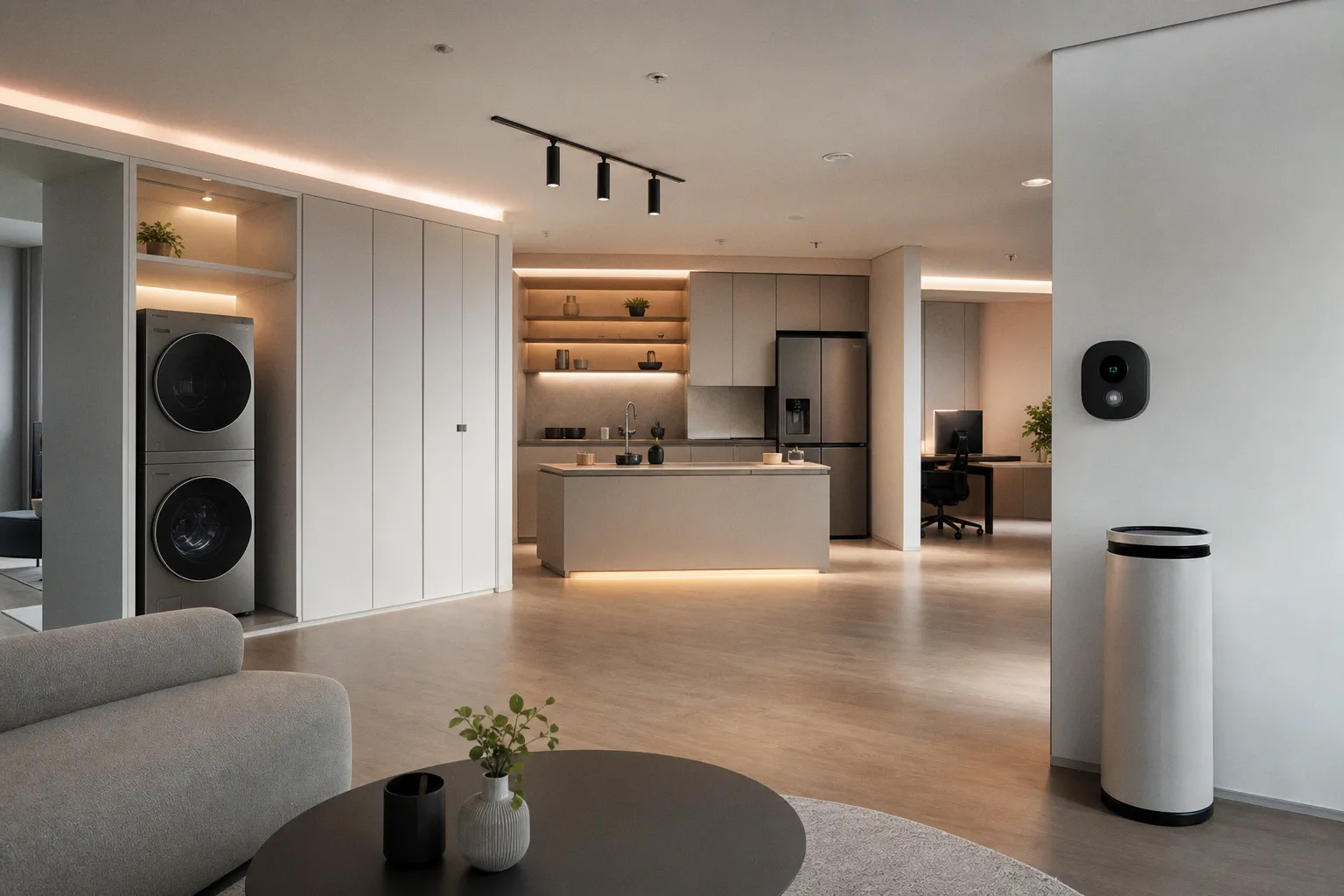
The confirmed public detail is narrow: LG is reported to have unveiled AI-powered smart home technologies at Africa Technology Expo 2026. That matters because the smart-home market is increasingly being framed around appliance intelligence rather than standalone gadgets — fridges, washers, cleaners, climate systems, and displays acting less like isolated devices and more like nodes in a household logic graph.
But the available source material does not give product names, technical standards, supported platforms, pricing, launch markets, or rollout dates for LG’s expo showing. So the correct read is: this is a market signal, not a deployment blueprint.
If you are planning a setup around LG hardware, the checklist is brutally simple. Do not buy the phrase “AI-powered” until the payload is visible: app behavior, automation triggers, supported ecosystems, account requirements, offline behavior, and whether device state can be used reliably by other systems. A smart home that cannot expose useful state is not smart; it is just a glossy appliance with opinions.
Smart living is getting cheaper — and more crowded
The broader context is that appliance automation is moving fast at multiple price points. Dreame Technology, for example, has announced the L50 Plus and L50 robotic vacuum cleaners in India, priced at INR 34,999 and INR 27,999 respectively, with availability through Amazon India and Dreame India’s website starting July 6, 2026.
Those models are pitched around 25,000Pa Vormax suction, dual-rotary mop pads with MopExtend for edge-to-corner cleaning, a 10.5mm mop lift intended to keep carpets dry, intelligent navigation, obstacle avoidance, anti-tangle brush technology, customizable vacuuming and mopping, long battery life, and app-based controls. Dreame also says the products come with a one-year warranty and support through an after-sales network spanning more than 160 cities in India.
Why does that matter in an LG expo story? Because it shows the pressure line. Smart-home brands are no longer competing only on hardware. They are competing on automation depth, support infrastructure, and how much daily friction they can remove without forcing users into a dead-end app silo.
That is the same filter LG’s AI smart-home pitch will have to pass. If an AI appliance can optimize a cycle but cannot participate cleanly in a broader home routine, it is only half integrated.
The risk layer is still part of the architecture
MSN’s recent smart-home coverage points to risks and challenges around the category, and that is the unglamorous part vendors prefer to route around. For anyone building a connected living space, the risk model is not optional config; it is the architecture.
Before treating LG’s expo announcement as a buying trigger, watch for the missing implementation details: which regions get the products, how long software support is promised, whether account-based cloud control is mandatory, how data is handled inside the AI features, and whether automations can survive when internet access drops. Also check whether the devices can coexist with the rest of your stack rather than demanding to become the stack.
The smarter move is to treat this announcement as an early webhook: useful, but not executable yet. When LG publishes actual device specs, compatibility notes, and rollout details, then the real work begins — mapping triggers, testing latency, checking failure modes, and deciding whether the AI layer is an automation engine or just another branded dashboard.