Switch to Matter smart led bulb options to bypass hub lock-in
A Hue Bridge died last month. Not the bulbs — the bridge. Three-year-old hardware, still-functional bulbs in every room, and suddenly half the house went dark on a Tuesday because the vendor decided the firmware update was the last one.
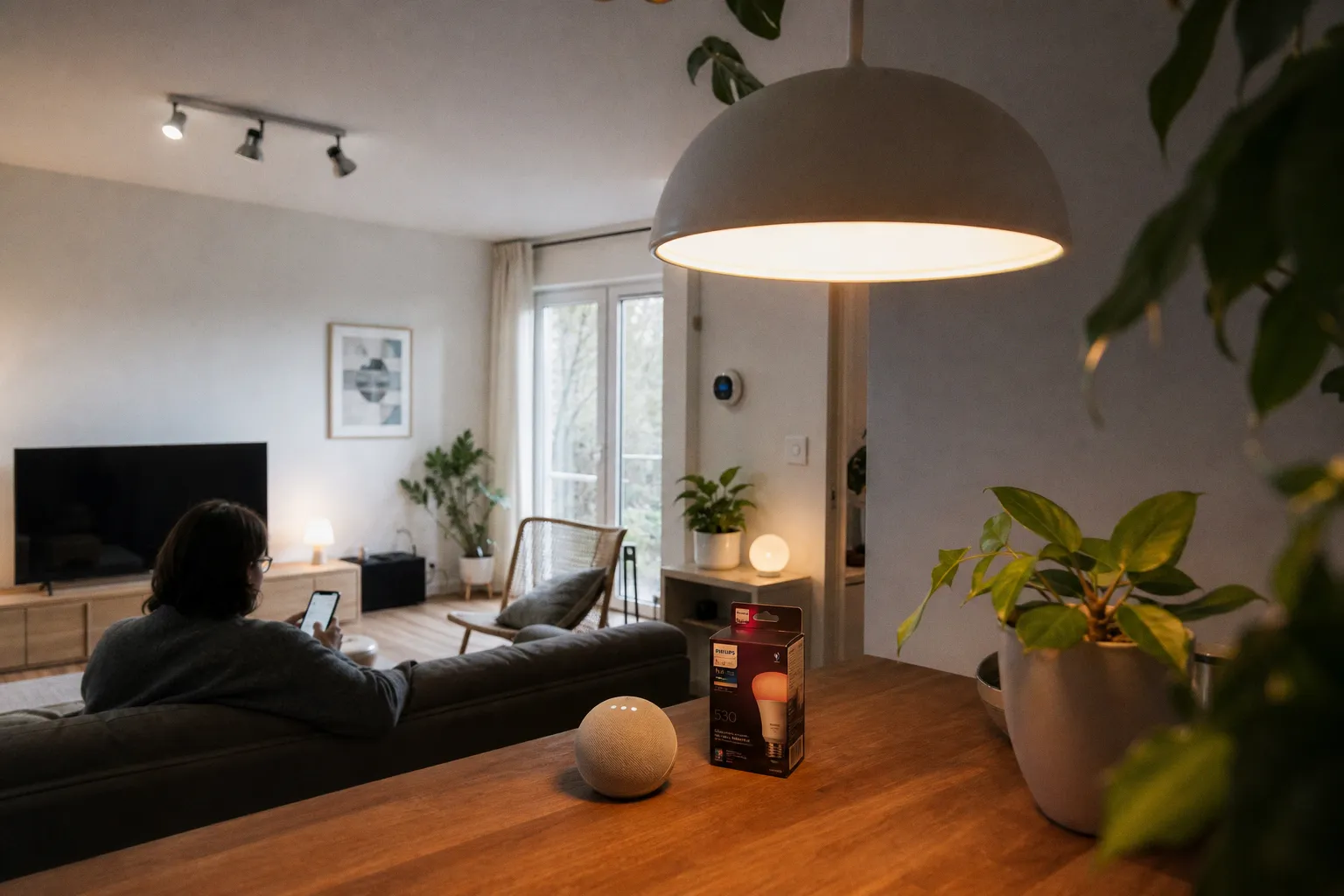
This is the story of how I ripped out the proprietary stacks and rebuilt around Matter — the IP-based standard that finally does what the marketing PDFs have been promising for a decade. Local control, cross-ecosystem orchestration, no cloud dependency on the command path. If you're weighing the switch, here's the architecture, the tradeoffs, and the install order I'd actually use.
The vendor lock-in tax you've been paying
Every smart lighting ecosystem is, structurally, a hostage negotiation. Philips Hue owns your bulbs through the Hue Bridge, even though the bulbs speak Zigbee — a perfectly good, mesh-capable protocol. LIFX used to own your bulbs through the cloud account, until the company was acquired and the servers started returning 502s for entire neighborhoods. Govee gives you a generous app, then asks you to create an account before flipping a switch. Each vendor's value proposition boils down to: we'll keep your lights working as long as you stay inside our fence.
The architectural reason isn't malice — it's business logic. A Zigbee bulb paired to a Hue Bridge will only be exposed to Apple Home or Google Home through Signify's API gateway, because the bridge translates Zigbee into the vendor's preferred control schema. Add a third party, and you have to maintain three integrations, three SDKs, three failure modes. Vendors solved that problem by simply not solving it. You stayed inside their app because the friction of leaving was too high.
The Matter shift isn't about adding features — it's about removing the vendor's veto power over your own light switch.
Matter reframes the entire negotiation. The Connectivity Standards Alliance shipped Matter 1.0 in October 2022 and the 1.3 spec in May 2024, and what they built is a control layer that sits underneath every smart home platform. A Matter-certified bulb advertises itself on the network using standard IPv6, exposes a standard cluster model (on/off, level, color), and accepts commands from any certified controller — Apple Home, Google Home, Alexa, SmartThings, Home Assistant — without a translation gateway. The cloud isn't on the command path. Local multicast does the work.
That's the shift worth understanding: when you replace a Hue Bridge with a Matter controller, you don't get a better bulb. You get a bulb that can no longer be locked.
How Thread and Wi-Fi reset the local control equation
Matter runs over two transports — Wi-Fi (your existing 2.4 GHz network) and Thread (an IEEE 802.15.4 mesh, IPv6-native, designed for low-power devices). Choosing between them is a real engineering decision, and the choice changes how your house behaves when the internet goes down.
Matter-over-Wi-Fi uses the same radios your laptop and phone already have. Pairing is fast, range is whatever your router can cover, and bandwidth is effectively unlimited. The downside: every bulb is a full IP node on your LAN, DHCP leases pile up, and if the bulb misbehaves, your network tools see it. In a 40-bulb installation, that's 40 extra MAC addresses to manage. Practical? Yes. Clean? Not especially.
Matter-over-Thread is the option I prefer for ambient lighting. Thread is a mesh: each mains-powered bulb acts as a router node, extending the network to bulbs that would otherwise be at the edge of radio range. Latency is lower because the packets don't traverse your router's firewall — they hop bulb-to-bulb at the 802.15.4 layer. The catch is the network itself needs to exist first. Thread Border Routers (the devices that bridge Thread to your IP network) are still relatively scarce — Apple TV 4K (2nd gen and later), HomePod (2nd gen), Nest Hub (2nd gen), and Echo (4th gen) all include one. If you don't have any of those, you either buy one or your Thread bulbs pair in a degraded state.
Don't pick a transport. Pick a failure mode. Which one survives your router rebooting and your ISP going down for six hours?
For most homes, the practical answer is a hybrid. Nanoleaf's Essentials bulbs ship with both Wi-Fi and Thread radios, so you start on Wi-Fi and migrate to Thread later when your Border Router shows up. Govee's Matter-over-Wi-Fi models are cheaper upfront but lose the mesh benefits. Hue's Matter-over-Bridge path keeps the Zigbee radio but adds Matter as a translation layer on top — reliable, but still vendor-mediated. The technical question isn't which transport is "best" — it's which one survives a router reboot and a power outage in the configuration you actually care about.
The Matter Controller question nobody answers cleanly
Matter did not kill the hub. It renamed it.
The marketing says "no hub required" and that's half true. You don't need a manufacturer-specific bridge to translate protocols anymore. But every Matter device still needs a Matter Controller — the device that holds the fabric credentials, manages commissioning, and exposes the device to whichever platform you're using. Without one, the bulb sits on the network as an unconfigured node and does nothing.
| Controller | Primary ecosystem | Thread Border Router | Notes |
|---|---|---|---|
| Apple HomePod (2nd Gen) | Apple Home | Yes | Required for Thread if you have no Apple TV 4K |
| Apple TV 4K (2nd Gen+) | Apple Home | Yes | The workhorse if you're Apple-centric |
| Google Nest Hub (2nd Gen) | Google Home | Yes | Cheapest path to Thread in a Google household |
| Amazon Echo (4th Gen) | Alexa | Yes | Bundled Thread radio, voice-first |
| SmartThings Hub v3 | SmartThings | Yes | The most platform-agnostic option |
| Home Assistant SkyConnect | Home Assistant | Yes | Tinkerer's choice, no cloud required |
The practical implication: your "hubless" smart home still needs at least one of these devices. The difference is that this hub is now an interchangeable component. If your Echo dies, the bulbs don't — they just need another Matter Controller to receive commands. That's the entire architectural win. You stop buying insurance policies on proprietary hardware.
If you're starting fresh today, I'd pick the controller based on which ecosystem you actually use for automations, not for voice control. Voice is the easy part — every modern assistant handles Matter. The deeper question is which app you'll be writing your routines in for the next three years. Home Assistant gives you the most leverage and the most pain. Apple Home gives you the cleanest UX and the least flexibility. Google and Alexa sit somewhere in the middle. There's no wrong answer if you've thought about what you'll be scripting.
Reading the field: which Matter bulbs are worth the install
A note before the table: the Matter logo on the packaging is not decoration. It's the contract. If a bulb doesn't have it, it's not Matter-compatible, regardless of what the product page implies. Don't assume. Verify.
| Brand / Model | Transport | Color | Hub-free | Notable quirks |
|---|---|---|---|---|
| Nanoleaf Essentials A19 | Thread + Wi-Fi | RGBWW | Yes | Brightness calibration is best in class |
| Nanoleaf Lines / Shapes | Thread | RGB | Yes | Design-first, not lumen-first |
| Philips Hue (post-Bridge update) | Zigbee + Matter bridge | RGBWW | Requires Hue Bridge | Matter layer is reliable, Zigbee still does the heavy lifting |
| Govee LED Strip M1 (Matter) | Wi-Fi | RGBIC | Yes | Cheapest path to addressable zones |
| TP-Link Tapo L535E | Wi-Fi | RGB | Yes | Solid driver, fewer third-party integrations |
The Hue row deserves a paragraph. Philips Hue updated the Hue Bridge firmware in 2023 to expose the Zigbee bulbs as Matter devices. The bulbs themselves didn't change — they're still talking Zigbee to the bridge, and the bridge is now also advertising them over Matter. The upside: every Hue bulb you've ever installed is now technically a Matter bulb. The downside: you've still got a Hue Bridge on your network, and if it dies, you're back to flashing bulbs and re-pairing. It is interoperability in the loosest sense.
Nanoleaf is the cleanest end-to-end Matter play today. Their Essentials line commissions directly into Apple Home, Google Home, or Alexa without a vendor app in the loop — though you'll want the Nanoleaf app for firmware updates. The bulbs feel slightly less polished than Hue's, but the architectural freedom is worth the trade.
Govee and Tapo are the budget tier, and they behave like it. Firmware update cadence is slower, the Matter cluster implementations are occasionally behind spec, and some advanced features (music sync, scene morphing) live behind vendor apps. If your lighting logic is simple on/off and color, they're fine. If you're scripting anything beyond a routine, you'll feel the friction.
Building for the version you don't know yet
The open secret of Matter is that the spec is still in motion. Matter 1.3 shipped in May 2024 with expanded energy and water management device types — lighting got refinements but no revolution. 1.4 is on the roadmap, and 1.5 will likely include whatever the working groups decide this quarter. The protocol itself is settling into a long-term curve, and that's actually the point.
What you build today should be able to absorb a spec change without a rip-and-replace. Concretely, that means three things.
1. Prefer bulbs that expose their clusters over Matter directly, not bulbs that translate from Zigbee or proprietary RF. A Nanoleaf Essentials bulb will receive a Matter 1.5 firmware update and continue working. A Hue bulb connected through the Hue Bridge will work as long as Signify maintains the bridge's Matter translation layer — which is outside your control.
2. Treat your Matter Controller as a swappable component, not a centerpiece. Write your automations in the ecosystem app (Apple Home, Google Home, Home Assistant) rather than relying on vendor-specific scenes. A HomeKit automation that triggers on a time of day and a Thread sensor will survive the Echo dying. A Nanoleaf rhythm scene won't survive Nanoleaf sunsetting the rhythm feature.
3. Keep one device off the standard. Reserve a single smart bulb — a floor lamp, a desk light — for experimentation. New Matter device types, beta firmware, vendor integrations you don't fully trust. Test there. The rest of your lighting should be on the boring, stable, supported path. This is the same principle as a canary deploy, just with photons.
If you've ever tried to read the tea leaves on which ecosystem will dominate in five years, disciplined signal-thinking is what separates a stack commitment from a stack gamble. The spec is still moving — and that's precisely the reason to build around interoperability rather than betting on any single vendor's roadmap staying intact. The frameworks that matter most are the ones you can audit: open-source controllers, standard cluster models, and a commissioning flow that doesn't require a vendor server to be online.
The final layer is documentation. Keep a spreadsheet — or a YAML file, if you're a Home Assistant household — listing every bulb's Matter device ID, the controller it's bound to, and the firmware version. When a vendor drops support, you don't want to be discovering that your living room is dark at 6 PM on a weekday. The whole point of switching off a proprietary stack is that you can swap a controller or a bulb in under five minutes, but only if you know what you're swapping.
The bottom line on the switch
Matter isn't perfect. The spec is complex, the controllers still require some literacy, and the early firmware updates have had the usual smart home rough edges. But it is the first lighting standard in a decade that treats vendor lock-in as an engineering problem worth solving, not a marketing message to dismiss.
The case for switching is not that Matter is better than Hue or LIFX or Govee at any single thing. The case is that Matter is owned by you, the person flipping the switch. When the cloud goes down, your lights stay on. When the vendor exits the market, your bulbs keep working. When Apple and Google have their next platform war, your lighting doesn't pick a side.
That's the architectural win. Everything else is packaging.