Compare Philips Hue vs LIFX Specs for Matter Homes
Two smart bulbs. One decision that isn't really about the bulb.
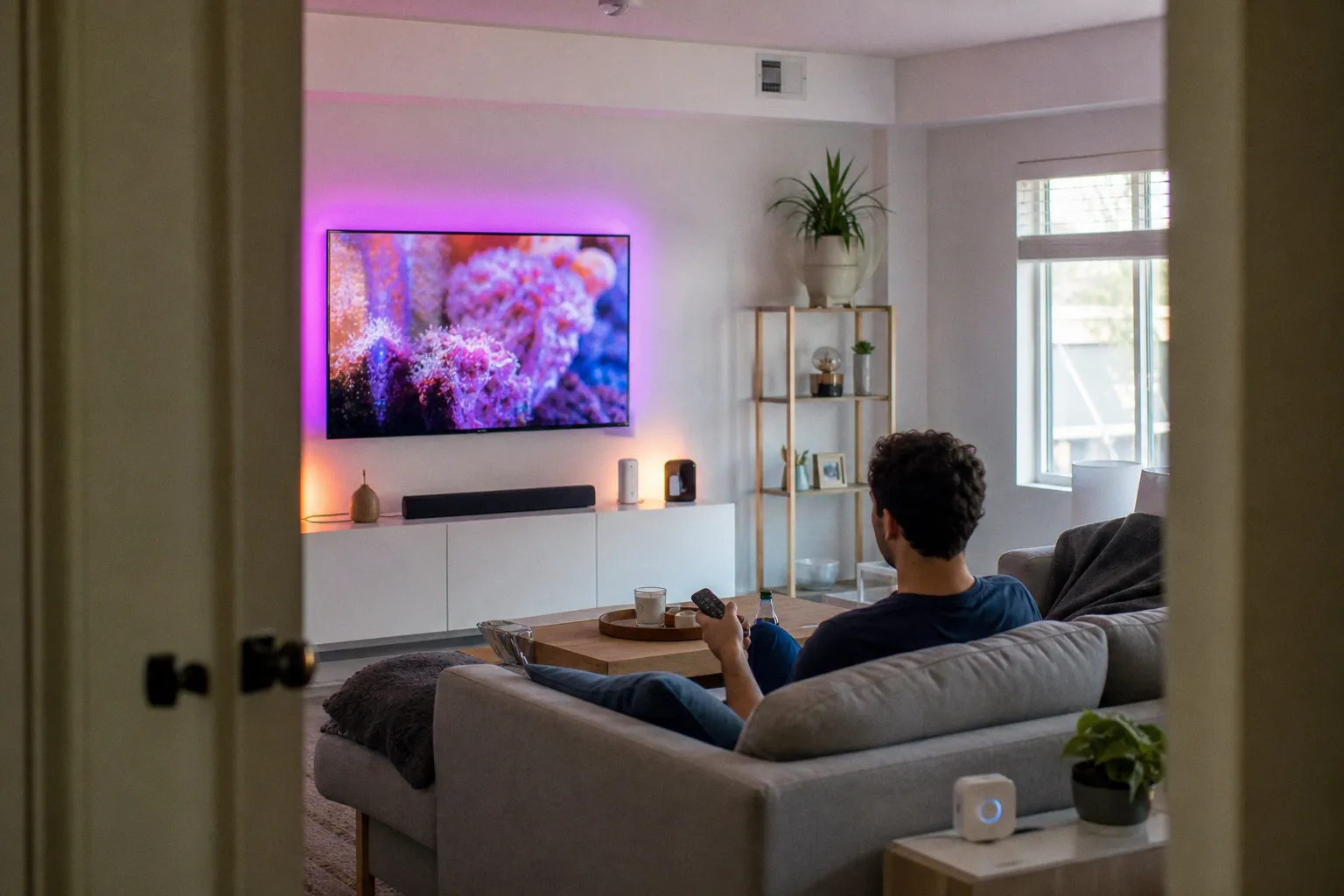
That's the awkward truth I keep coming back to when people ask me whether they should buy Philips Hue or LIFX. The hardware is comparable, the color ranges overlap, and both now speak Matter. What actually separates them is the invisible plumbing underneath: one routes through a Zigbee bridge, the other talks directly to your Wi-Fi router. That single architectural choice ripples through everything - your setup time, your router's sanity, your ability to keep the lights on when the internet drops, and how deep you can go with sensors and automations.
So instead of picking a "winner," let's walk through what each platform actually does, where it stumbles, and which one maps to the way you live.
The Network Architecture Divide: Bridge vs. Direct Wi-Fi
The biggest difference between Philips Hue and LIFX has nothing to do with the bulb itself. It's whether your bulb needs a translator.
Philips Hue bulbs speak Zigbee, a low-power mesh protocol that doesn't talk directly to your home router. Instead, every Hue bulb communicates with a small white box called the Hue Bridge, which then connects to your network via Ethernet. That Bridge is the brain - it stores your scenes, runs your automations, and relays commands to every bulb, switch, and sensor in the system.
LIFX took a different path. Their bulbs connect directly to your 2.4GHz Wi-Fi network, the same one your phone and laptop use. No hub, no bridge, no extra box on your shelf. You screw the bulb in, open the app, and it joins your network.
For someone setting up two or three lamps in a living room, that LIFX simplicity is genuinely appealing. One less box to power, one less thing to update, one less subscription-style gateway in your closet.
But here's where it gets interesting. Zigbee isn't just a workaround - it's a mesh. Every powered Hue bulb extends the network's reach by repeating the signal to the next bulb. That means a 40-bulb installation in a large house doesn't overload your Wi-Fi with 40 separate clients; it just works. LIFX, by contrast, puts every bulb on your wireless network as its own client. If your router was already struggling with phones, laptops, smart speakers, and security cameras, adding two dozen Wi-Fi bulbs is a real load.
The bridge-versus-no-bridge question isn't really about convenience - it's about what your home network can comfortably carry.
For a long time, smart home brands tried to pretend the network layer didn't matter to regular buyers. In 2025, it does - especially as households pile on more connected devices.
Brightness, Color, and the Polychrome Question
On pure output, LIFX tends to come out ahead in the lumen race. A standard LIFX A19 bulb typically lands between 1,100 and 1,200 lumens, while a comparable Philips Hue A19 sits closer to 800 to 1,100 lumens depending on the model. If you're lighting a vaulted entryway or a kitchen where you genuinely need daylight-level brightness for chopping and reading recipes, those numbers aren't trivial.
Both brands cover a 2,000K to 6,500K color temperature range, so you get the warm candlelight glow and the cool task light from the same bulb. Whites look good on both - crisp, not greenish, not pink. Neither brand has the "muddy white" problem that plagued early-generation smart bulbs.
Where things get genuinely different is color. Standard Hue bulbs are single-color-at-a-time: one bulb, one hue. That's perfectly fine for most rooms. But LIFX has leaned into something they call Polychrome Technology, which is built into their light strips and certain specialty bulbs. A single LIFX strip can display multiple colors simultaneously - sunset gradients, rainbow effects, animated scenes. If you want the kind of under-cabinet glow that shifts from amber to violet across six inches of strip, LIFX has more native options out of the box.
For ambient lighting behind a TV, along a kitchen backsplash, or wrapped around a desk, Polychrome gives you visual interest that single-color bulbs just can't replicate without help.
| Parameter | Philips Hue | LIFX |
|---|---|---|
| Network | Zigbee (requires Hue Bridge) | 2.4GHz Wi-Fi (no hub) |
| Typical A19 Brightness | 800–1,100 lumens | 1,100–1,200 lumens |
| Color Temperature Range | 2,000K–6,500K | 2,000K–6,500K |
| Multi-Color on a Single Device | Limited (zones on newer strips) | Yes - Polychrome Technology |
| Works Offline (No Internet) | Yes, via Bridge + Zigbee mesh | Partial - local Wi-Fi control only |
| Matter Support | Via Bridge firmware update (2023) | Selected bulbs only - verify model |
Matter Support and What It Actually Gets You
Matter is supposed to be the great equalizer - one protocol that lets Apple Home, Google Home, Amazon Alexa, and SmartThings all talk to the same device without ceremony.
Both Philips Hue and LIFX have embraced Matter, but the implementations are not equivalent.
Philips Hue added Matter to the entire ecosystem via a firmware update to the Hue Bridge in 2023. Once your Bridge is on the updated firmware, every Hue bulb, light strip, and accessory connected to it can be exposed to Matter-compatible platforms. The Bridge essentially becomes a Matter bridge - a translation layer between Zigbee and the new standard. This is important: individual Hue bulbs cannot connect directly to a Matter controller without going through the Bridge. There's no way around that architectural requirement, no matter how much you might wish otherwise.
LIFX began rolling out Matter support for select Wi-Fi smart bulbs in 2023 and continued through 2024. The catch is that not every LIFX bulb is Matter-compatible. Older legacy models may not be supported, so if you're buying secondhand, replacing one specific bulb that died last year, or holding onto an older generation LIFX strip, double-check the model number against the current compatibility list before you assume Matter will work.
In practical terms, what does Matter actually unlock? It lets you put a Hue bulb and a LIFX bulb in the same Apple Home scene. It lets Google Home see both without juggling two apps. For people deep in a specific ecosystem - all-Apple, all-Google, all-Alexa - this is genuinely useful. The lights finally stop being tribal.
But Matter doesn't erase the underlying architecture. A Matter-enabled Hue bulb is still talking to its Bridge, which then bridges to Matter. A Matter-enabled LIFX bulb is still a Wi-Fi client on your network. The protocol on top changed; the wiring underneath didn't.
Matter didn't unify your smart home - it unified the apps you use to talk to two different kinds of smart homes.
Reliability When Things Go Wrong
This is where the philosophical divide between these two systems becomes painfully obvious.
Take your internet out. Comcast has an outage, your fiber box reboots, a storm rolls through. What happens to the lights?
With Philips Hue, the answer is: almost everything still works. The Hue Bridge runs locally. Your Zigbee mesh keeps functioning. Dimmer switches, motion sensors, and scheduled routines stored on the Bridge all continue to operate without any cloud connectivity. You can still press a physical switch and watch the lights respond. That's a meaningful advantage in a household where someone needs the hallway light at 2 a.m. and the router is in the middle of a firmware update.
LIFX handles the outage scenario differently. Local Wi-Fi control is technically possible - if your phone is on the same network as the bulbs, the LIFX app can talk to them directly. But the moment your router reboots and the bulbs take a few minutes to reconnect, the experience can feel brittle. Schedules, scenes, and integrations often rely on cloud connectivity. Lose the internet and you lose a meaningful chunk of what made the bulbs smart in the first place.
For an apartment with a handful of bulbs, this difference is mostly academic. For a whole-home installation - hallways, kids' rooms, outdoor fixtures, garage, basement - it's not. Reliability under network failure is one of those things you don't think about until you need it, and by then it's too late to switch systems without re-pairing dozens of devices.
The Accessory Ecosystem and Expansion
Here's where Philips Hue earns its reputation as the deeper platform.
Because Hue runs on Zigbee, the same protocol used by dozens of other manufacturers, the accessory ecosystem is enormous. Hue-branded dimmer switches, motion sensors, smart buttons, outdoor fixtures, light strips, and even third-party Zigbee devices can join the same Bridge. Once they're paired, they continue to work even when the internet is down. You can walk into a dark laundry room, trigger a motion sensor, and have the lights come up without anything in the cloud being involved.
LIFX doesn't really have a comparable accessory universe. There are integrations - voice assistants, smart home platforms, IFTTT - but the physical switch, sensor, and controller ecosystem is thin. You control LIFX bulbs mostly through the app or via voice. That's fine for many setups, but if you want a tactile wall switch that doesn't require your phone or a voice command to operate, Hue is the more mature choice.
What about expansion? If you're starting with a single lamp and you plan to grow to a whole-home system over years, Hue's Bridge-based architecture scales more gracefully. You can add a hundred bulbs without flooding your Wi-Fi with a hundred clients. The accessory ecosystem means you can build automations - "if motion is detected in the laundry room after 10 p.m. and no one's been in there for an hour, turn on the closet light at 15%" - that feel genuinely useful rather than gimmicky.
LIFX's expansion story is simpler. You buy a bulb, you add it to your Wi-Fi. You buy another, you add it. At some point, depending on your router's capacity, you may hit a wall where the network is saturated and performance becomes inconsistent. For most households, that ceiling is high enough that you'll never hit it. But it's worth knowing it exists, especially if you're in an apartment building where every neighbor's router is also crowding the 2.4GHz band.
Whose Daily Life Actually Benefits
The question of Philips Hue versus LIFX isn't really a head-to-head; it's a question of what your home is doing and what you expect from it.
If you're a renter with two lamps in a studio, if you want one ambient strip behind your TV, if you'd rather not buy a hub and you already have a solid Wi-Fi router - LIFX gives you a cleaner, simpler experience. You get Polychrome color effects, solid brightness, and Matter support on most current models. The setup takes minutes, and you won't be troubleshooting a Bridge that you didn't really need.
If you're a homeowner outfitting a multi-room system, if you want automations that work even when the internet drops, if you care about dimmer switches and motion sensors and the kind of granular control that turns a house into a responsive environment rather than a collection of app-controlled bulbs - Philips Hue is the more mature, more reliable platform. The Bridge is a commitment, but it's a commitment that pays off in stability, ecosystem depth, and offline resilience.
What both brands do well in 2025 is something previous generations of smart bulbs couldn't: they coexist. Matter means you can run LIFX strips behind your media console, Hue bulbs in your ceiling fixtures, and a mix of everything else, all from a single app. For a deeper look at how connected ecosystems are reshaping daily routines beyond lighting, the team at cosmo2tree.com has been covering this convergence from a slightly different angle.
Pick the platform that matches your network, your tolerance for hubs, and your appetite for accessories. The light itself is good either way - the difference is in what happens when the lights are part of a house that has to keep working.