Choose Battery or Wired Video Doorbells for Cold Winters
Last February, I missed a package I had been tracking for three days. Not because the courier never rang — they did, twice. The doorbell was dead, and I didn't know it yet. When I finally pulled it off the mount, the battery indicator showed 4%.
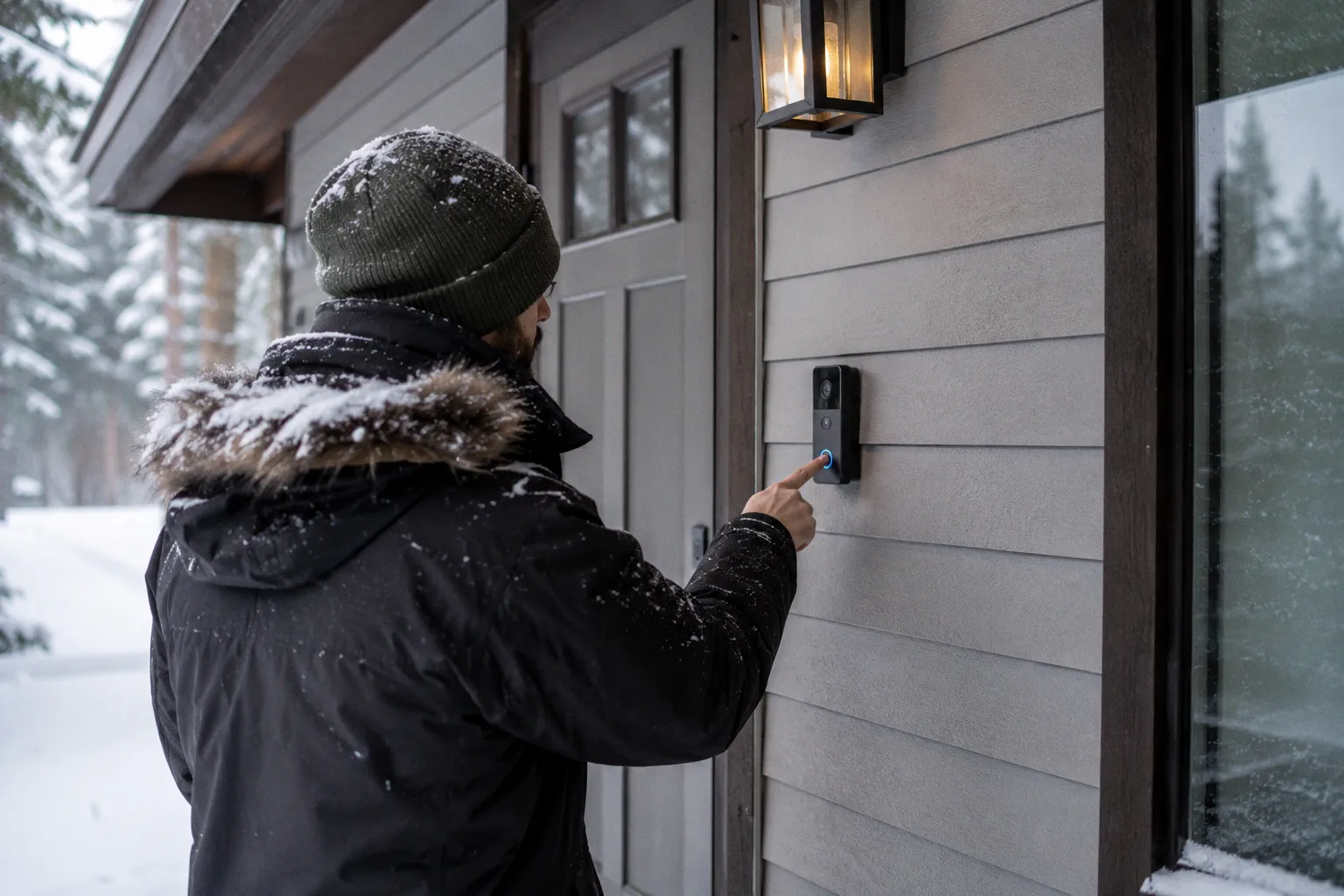
# Winter-Proofing Your Entryway: Choose Battery or Wired Video Doorbells for Cold
The Physics of Battery Failure in Sub-Zero Conditions
A lithium-ion cell doesn't just "lose charge faster" when it gets cold. The chemistry inside it changes. Below 0°C (32°F), the electrolyte thickens, lithium ions move sluggishly between the anode and cathode, and the internal resistance climbs. The result isn't a slow decline — it's a cliff. A battery that shows 60% on a mild autumn morning can drop to 12% overnight once the temperature dips below freezing, and a unit rated for −20°C may still shut down entirely at the lower end of its operating range because the protection circuit trips before the cell can be damaged.
Most consumer-grade battery doorbells are advertised for an operating window of roughly −20°C to 50°C (−4°F to 122°F). That number is honest, but misleading. It tells you the device will power on at those extremes; it does not tell you that at the cold end of the range, runtime collapses, motion detection becomes laggy, and the Wi-Fi radio struggles to maintain a stable link back to your router. The published spec is a survival threshold, not a performance threshold. In real households — in driveways, on north-facing porches, in places where the wind chill is the real story — you are operating well below the comfort zone the marketing team imagined when they wrote that range.
Below 0°C, your lithium-ion battery isn't just tired. It's chemically reluctant to give you anything at all.
This is also why the "cold weather cover" or third-party silicone sleeve you saw on a forum thread isn't a real fix. There is no standardized test data showing those accessories meaningfully insulate a battery through a Winnipeg February. They might shave a degree or two off the wind chill. They will not undo the chemistry.
Why Constant Power Is the Gold Standard for Winter Reliability
A wired video doorbell draws from your home's existing low-voltage transformer, typically 16V to 24V AC. That current is always there, humming through the doorbell wires whether the temperature outside is +30°C or −30°C. The doorbell is not storing energy in a stressed cell and hoping for the best. It is being fed, continuously, by the same wiring that rang the dumb mechanical chime in your wall for the last thirty years.
This is the single biggest reason wired doorbells outperform in cold climates. The physics problem of the lithium-ion cell simply does not apply, because there is no cell doing the work. The doorbell's processor, camera sensor, Wi-Fi radio, and (in many cases) heater all run on household current. The transformer doesn't care what the weather is doing. As long as the wires aren't physically damaged by ice or shifting trim, the device stays alive.
If you're trying to choose between battery and wired video doorbells for cold, the practical takeaway is this: in any region where winter regularly hits −10°C or below, a wired installation removes the single most fragile component from the equation. You still need to think about the camera lens frosting over, the chime connector behavior, and your Wi-Fi signal strength through insulated walls — but the power question is settled. The doorbell will be on when you need it to be on.
| Parameter | Battery Doorbell | Wired Doorbell (16–24V AC) |
|---|---|---|
| Cold-weather power source | Lithium-ion cell (chemistry degrades below 0°C) | Household transformer, constant current |
| Typical operating range | −20°C to 50°C, but performance collapses near the cold end | Same, but powered continuously across the range |
| Risk of mid-winter failure | High — sudden shutdown, rapid drain | Low — power is independent of outdoor temperature |
| Installation effort | Drill, mount, charge, hope | May require transformer upgrade or chime bypass |
| Backup during outage | Battery keeps it running briefly | No battery (unless model includes one) |
| Best for cold climates | Mild winters, sheltered porches, renters | Harsh winters, exposed entries, year-round reliability |
The Hidden Role of Internal Heating Elements in Wired Systems
Here is the part that doesn't show up on the spec sheet but matters enormously once you live with the device for a season. Several of the better wired doorbells — including the higher-tier models from Ring, Nest, Eufy, and a few others — contain a small internal resistive heater. It is not a marketing gimmick. It activates automatically when the internal temperature sensor drops below a threshold (usually somewhere between −5°C and −10°C, depending on the model), and its job is twofold: keep the camera lens clear of frost and condensation, and keep the core electronics within a comfortable working range.
A frosted lens is a silent failure. The doorbell still "works." The app still shows a live view. But the image is a milky blur, motion detection misses faces, and you cannot identify the person who just walked off with your delivery. This is the failure mode I see most often in cold-climate complaints online, and the heaters are specifically engineered to address it. The heater draws a small amount of extra current from the transformer, which is one more reason a properly rated transformer matters: an underpowered 16V transformer may struggle to feed both the doorbell and the heater during a cold snap, which is why some installations call for a 24V upgrade.
Constant power isn't a luxury in winter. It is the entire game.
When you compare battery and wired video doorbells for cold, the heater is an asymmetry you should not ignore. Battery doorbells cannot run a heater. The cell would drain in hours. So even a battery model with a "cold weather" SKU is fighting a war on two fronts: it cannot keep itself warm and it cannot run on stored power efficiently while cold. A wired model with a heater is the only configuration that genuinely solves both.
Navigating the 0°C Charging Cutoff for Lithium-Ion Cells
There is a wrinkle that confuses people, and it caught me too. Some wired doorbells still contain a small internal backup battery — a tiny lithium-ion cell that keeps the device alive for a few hours during a power outage, or buffers the chime signal locally. It is reassuring to have. It is also the reason a wired doorbell with backup can still misbehave in deep cold, because the same chemistry rules apply to that small cell as to the big one in a battery-only unit.
Below 0°C, most lithium-ion charging circuits are designed to disable charging entirely. The reason is not laziness — it is protection. Forcing a charge into a frozen lithium-ion cell can cause permanent damage: lithium plating on the anode, irreversible capacity loss, in rare cases thermal runaway once the cell warms up. So the firmware simply refuses. The doorbell stays powered from the transformer, but the backup cell is not refilling. If you have a stretch of severe cold followed by a power outage, you may discover that the backup you thought you had is at 40%, not 100%. The doorbell will still work during the outage, but for a shorter window than the marketing claims.
If you live somewhere with frequent winter blackouts — rural areas, the edges of ice-storm country, anywhere a squirrel taking out a substation translates into a 14-hour evening — this matters. The fix is usually environmental rather than electronic: mounting the doorbell under a small eave or porch roof keeps the backup cell a few degrees warmer, which is often the difference between "charging enabled" and "charging locked out." The same principle applies to battery-only models. Sheltering the device from direct wind and snow buys you more uptime than any spec sheet improvement.
Strategic Installation Tips for Maintaining Connectivity in Harsh Winters
A working doorbell is more than a charged cell or a live wire. It is a small computer trying to stream video over your Wi-Fi, motion events trying to reach your phone, and a chime trying to ring inside the house. Cold weather punishes every link in that chain. A few installation habits go further than people expect:
- Mount on a sheltered wall when possible. Under an eave, in a recessed entryway, or on a wall with a small overhang. The goal is not to keep the doorbell warm — that is unrealistic — but to keep wind-driven snow and ice off the lens and off the body.
- Check your transformer voltage. If your home has the original 16V mechanical doorbell transformer from 1998, consider a 24V upgrade before you install a power-hungry wired doorbell. The cost is around $20 and ten minutes at the breaker panel.
- Bring battery models inside for charging. If you do run a battery doorbell in a cold climate, do not try to top it up with a partial charge outdoors in winter. Bring the whole unit (or the removable cell) inside, let it warm to room temperature, charge it, and remount. Charging a cold lithium-ion cell damages it.
- Test your Wi-Fi signal at the door. The single most common "my doorbell doesn't work in winter" complaint I hear is actually a Wi-Fi complaint. Cold walls, ice buildup on the exterior, and a router in the basement conspire to weaken the signal exactly when you need it most. A $30 mesh node or a weatherproof outdoor extender can fix it.
- Avoid mounting on metal doors or trim. Metal conducts cold straight into the device body and radiates it into the battery bay. Wood, vinyl, or fiber-cement siding buffers much better.
One more piece of the picture worth mentioning: home security does not stop at the front step. A doorbell that captures a porch pirate on video is useful, but the broader financial layer of your connected home — how you handle refunds, disputes, and the digital side of package protection — is its own conversation. A useful primer on financial security in a connected world covers that side of the equation well, and it pairs naturally with the hardware choices above.
The Bottom Line for Cold-Climate Buyers
If you are deciding between battery and wired video doorbells for cold, the answer is honest and unfussy. Battery doorbells are wonderful for renters, for sheds and side entries where running wire is impractical, and for regions where winter means "occasionally chilly." In any climate where the thermometer spends serious time below freezing, a wired installation is not a small upgrade — it is the correct category of product. You are removing the single weakest component (the cold-sensitive cell) and replacing it with something the house already provides.
Add an internally heated wired model if your budget allows, upgrade the transformer if it is under-spec, and put the device somewhere the wind cannot punish it. Do those four things and you will not be standing in your kitchen in February holding a dead doorbell, wondering why the package never came. You will be inside, warm, watching the delivery driver wave at the camera from your phone, and the doorbell will still be at 100% in the morning.
That is the whole job. Everything else is detail.